



Contents
- 1 What Is the Repo Rate and Why Does It Matter?
- 2 Current RBI Policy Rates: A Complete Snapshot
- 3 Neutral Stance Continues: What Does It Signal?
- 4 Impact on Home Loan and Personal Loan EMIs
- 5 GDP Growth Forecast Revised Upward to 6.7%
- 6 Why the RBI Chose to Hold Rates
- 7 What Should Borrowers and Investors Do Now?
RBI Repo Rate Unchanged at 5.25% in August 2026 MPC Meeting: What It Means for Your Home Loan EMI: The Reserve Bank of India (RBI) has once again opted for a status-quo approach on interest rates. Following the latest Monetary Policy Committee (MPC) meeting held on August 5, 2026, the central bank, under Governor Sanjay Malhotra, decided to keep the benchmark repo rate unchanged at 5.25%.
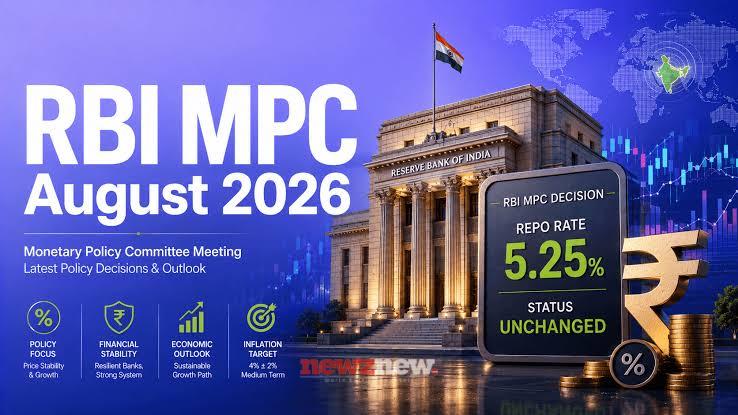 This marks the fourth consecutive policy review in which the RBI has chosen to hold rates steady, signalling a cautious yet stable approach to India’s monetary policy amid evolving domestic and global economic conditions.
For millions of borrowers across the country tracking every RBI announcement for its impact on their finances, this decision brings a sense of predictability. Loan EMIs, whether for homes, vehicles, or personal needs, will remain unaffected in the immediate term, offering relief to households already managing tight monthly budgets.
What Is the Repo Rate and Why Does It Matter?
The repo rate is the interest rate at which the RBI lends short-term funds to commercial banks. It is one of the most closely watched tools of monetary policy because changes in this rate directly influence the cost of borrowing across the economy.
When the RBI raises the repo rate, banks typically pass on the higher cost to consumers through increased interest rates on loans. Conversely, a rate cut usually results in cheaper loans and lower EMIs. By holding the repo rate steady at 5.25%, the RBI has effectively maintained the current lending environment, giving both banks and borrowers a stable framework to plan around.
Current RBI Policy Rates: A Complete Snapshot
Alongside the repo rate, the RBI also maintains a set of other key policy rates that together shape the liquidity and lending landscape in the banking system. Here is a breakdown of where things currently stand after the August 2026 MPC meeting:
- Repo Rate: 5.25% — the rate at which the RBI lends short-term money to commercial banks
- Standing Deposit Facility (SDF) Rate: 5.00% — the rate at which banks can park surplus funds with the RBI without collateral
- Marginal Standing Facility (MSF) Rate: 5.50% — the rate at which banks can borrow overnight funds from the RBI against government securities
- Bank Rate: 5.50% — the rate at which the RBI provides long-term funds to banks
This corridor of rates gives a clear picture of the RBI’s overall monetary policy framework, with the repo rate remaining the key benchmark that influences lending rates across banks, NBFCs, and housing finance companies.
Neutral Stance Continues: What Does It Signal?
One of the most significant aspects of this MPC meeting is the RBI’s decision to retain its “neutral” policy stance. Unlike an “accommodative” stance, which typically signals future rate cuts, or a “hawkish” stance that points toward potential hikes, a neutral stance suggests that the central bank is keeping its options open.
It indicates that future rate decisions will be data-dependent, based on how inflation, growth, and external factors such as global commodity prices and geopolitical developments evolve in the coming months.
This is the fourth straight policy meeting where the MPC has chosen to pause on rate action, reflecting the RBI’s confidence that the current rate levels are appropriately balancing the twin objectives of controlling inflation and supporting economic growth.
Impact on Home Loan and Personal Loan EMIs
For existing borrowers, the immediate takeaway is straightforward: there will be no immediate change to home loan, personal loan, or other retail loan EMIs, since these are largely linked to the repo rate through external benchmark lending rates. Borrowers on floating-rate loans linked to the repo rate will continue paying the same EMI amount as before this announcement.
For prospective homebuyers, this rate stability could actually work in their favour. With the festive season approaching, many real estate analysts believe that unchanged interest rates, combined with festive discounts and offers from developers, could give a boost to home sales.
However, affordability concerns persist for many buyers, particularly in metro cities where property prices have continued to rise even as interest rates have remained flat. Buyers are advised to factor in not just the interest rate but also property prices, stamp duty, and their own repayment capacity before making a purchase decision.
For those considering a new loan, this is also a good time to compare offers across banks and NBFCs, since a stable repo rate environment often means lenders compete more aggressively on processing fees and other charges to attract borrowers.
Industry leaders from the real estate sector have also welcomed the RBI’s decision.
Tejpreet Singh Gill, Managing Director, Gillco Group, said, “The RBI’s decision to maintain the repo rate at 5.25% provides much-needed stability for the housing market. With home loan rates expected to remain stable, buyers can plan their purchases with greater confidence, while developers can continue investing in project execution and future developments. The residential market has remained resilient, with housing demand continuing to be driven largely by end-users despite global economic uncertainties. In Punjab, improving infrastructure, expanding urban centres and a growing preference for organised townships and integrated communities are further strengthening buyer confidence. We believe this policy continuity will help sustain the sector’s growth momentum in the months ahead.”
Echoing similar sentiments, Gurinder Bhatti, Chairman and Managing Director, GB Realty, said: “By maintaining the repo rate at 5.25%, the RBI has ensured stability at a time when the housing sector continues to benefit from healthy end-user demand and improving buyer sentiment. Punjab is no longer solely an NRI-driven market as we are witnessing a growing base of local homebuyers looking to upgrade to organised, high-quality developments. Stable interest rates provide predictability in borrowing costs, strengthen buyer confidence, and encourage long-term investment in housing. Coupled with accelerating infrastructure development and rapid urbanisation, Punjab is well positioned to emerge as one of North India’s most promising real estate destinations. We believe this policy continuity will further support sustainable growth across the residential sector.”
GDP Growth Forecast Revised Upward to 6.7%
In a notable positive development, the RBI has revised its GDP growth forecast for the current fiscal year upward to 6.7%. This upward revision reflects growing confidence in India’s economic resilience, supported by steady domestic consumption, healthy services sector performance, and improving investment activity. A stronger growth outlook, combined with a stable interest rate regime, paints an encouraging picture for businesses, investors, and consumers alike as India navigates a complex global economic landscape.
The improved growth projection also suggests that the RBI sees limited near-term risk of an economic slowdown that would necessitate a rate cut, reinforcing its decision to maintain the current policy stance.
Why the RBI Chose to Hold Rates
Several factors likely influenced the MPC’s decision to keep rates unchanged for the fourth consecutive time:
- Inflation Management: Keeping rates steady helps the RBI continue monitoring inflation trends without introducing additional volatility into the credit markets.
- Growth Momentum: With GDP growth projected at a healthy 6.7%, there is less urgency to stimulate the economy through rate cuts.
- Global Uncertainty: Ongoing geopolitical tensions, including developments in West Asia, continue to create uncertainty in global commodity and currency markets, prompting the RBI to adopt a wait-and-watch approach.
- Banking System Stability: A stable rate environment supports predictable liquidity management for banks and financial institutions.
What Should Borrowers and Investors Do Now?
With the repo rate holding steady, financial experts generally suggest the following approach for different types of stakeholders:
- Existing Borrowers: Continue with your current EMI schedule. If you have a floating-rate loan, keep an eye on future MPC announcements, as any future rate cut could reduce your EMI burden.
- Prospective Homebuyers: This could be a good window to lock in a home loan, especially with festive season offers likely to be layered on top of stable interest rates.
- Depositors and Savers: Since deposit rates are also influenced by the repo rate, fixed deposit returns are likely to remain stable in the near term, making this a reasonable time to consider locking in current FD rates.
- Investors: A stable rate environment combined with a stronger GDP growth outlook could be positive for equity markets, particularly in interest-rate-sensitive sectors such as banking, real estate, and automobiles.
The RBI’s decision to keep the repo rate unchanged at 5.25% for the fourth consecutive MPC meeting reflects a measured, stability-focused approach to monetary policy. With the policy stance remaining neutral and GDP growth projections revised upward to 6.7%, the central bank appears confident in India’s current economic trajectory. For borrowers, this means continued predictability in EMI payments, while for the broader economy, it signals a balanced approach to sustaining growth without stoking inflationary pressures.
As the festive season approaches, all eyes will now turn to how banks and housing finance companies respond with their own promotional offers, and whether the next MPC meeting brings any shift in the RBI’s stance. Until then, the message from Mint Street is clear: stability remains the priority.
Stay tuned to NewzNew.com for the latest updates on RBI policy announcements, EMI impacts, and personal finance news.